

There is a graph doing the rounds that, at first glance, seems to say something very simple: people who identify as “very liberal” (in Australia can be read as ultra-left leaning) report much higher rates of having received a professional mental-health diagnosis than people elsewhere on the political spectrum.
It is tempting to grab a chart like that and turn it into a blunt conclusion. That would be a mistake.
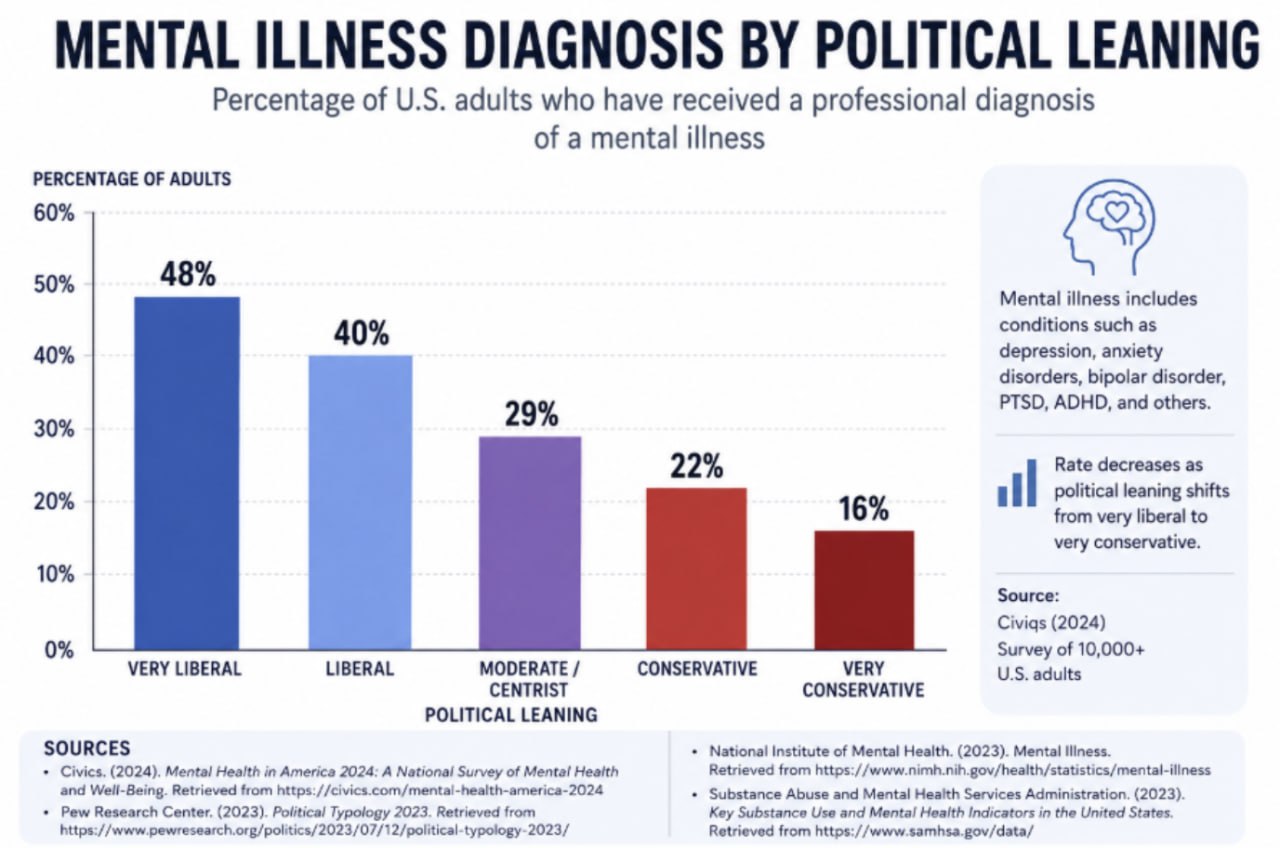
The graph does not prove that liberal (left leaning) politics causes mental illness. It does not prove conservatives are mentally healthier. It does not even measure “mental illness” in a clean, clinical way. It measures people saying they have received a professional diagnosis. That can reflect many things: age, access to healthcare, willingness to seek help, openness about diagnosis, social stigma, education, gender mix, political identity, and the language people use to describe themselves.
It is also a chart about U.S. adults, not a clinical assessment of any one person. So it should not be treated as a magic key that explains everything.
But it does raise a useful question.
When we look at someone like Geelan, are we seeing mental illness alone? Or are we seeing something more complicated?
That is the question worth asking, carefully.
Because the behaviour is not just political disagreement. It often looks obsessive. It repeats itself. It escalates. It seems to need an enemy. It seems to need an audience. It takes ordinary events and folds them into a larger story of grievance, betrayal, righteousness, or persecution. Once that pattern starts, everything can become proof of the story.
But is that a medical issue? A personality issue? A political identity issue? A social-media incentive issue? Or some mixture of all of them?
That is where the graph is useful, not as proof, but as a prompt. It reminds us that politics and mental health do not live in separate boxes. People bring their fears, needs, wounds, loneliness, status anxieties, and personal histories into politics. Then online politics gives those feelings a stage, a script, and an audience.
For some people, politics becomes less about policy and more about identity. It gives them a tribe. It gives them enemies. It gives them certainty. It gives them a way to explain why they feel wronged. It can even give them attention, especially when their behaviour becomes more extreme.
So when we watch Geelan, maybe the better question is not “is he mentally ill?” That is too simple, and it pretends we can diagnose someone from the outside.
The better question is: what is rewarding this behaviour?
Is he being driven by genuine distress? By ideology? By the need to be seen? By the thrill of conflict? By an audience that encourages escalation? By a worldview that turns every criticism into persecution? By a political culture that increasingly rewards people for performing certainty and outrage?
Maybe the answer is not one thing.
And that matters, because if we reduce it all to mental illness, we miss the environment around him. We miss the followers who validate it. We miss the platforms that reward it. We miss the way political identity can absorb personal grievance and make it feel noble. We miss the possibility that the behaviour is being shaped not only by what is happening inside one person, but by what he gets back from the world every time he performs it.
That does not mean sympathy has to become excuse-making. Harmful behaviour is still harmful. Obsession is still obsession. Public attacks, distortions, and harassment do not become acceptable because someone may be distressed.
But if we want to understand what we are watching, we need better questions than slogans.
The graph asks one question in the background: why do some political identities appear so closely associated with reported diagnosis, distress, or therapeutic language?
Geelan asks another: when politics becomes personal identity, personal grievance, public performance, and emotional release all at once, what exactly are we looking at?
Maybe that is what is going on with our friend Scoop.
Not a neat diagnosis. Not a clean political explanation. Something messier: a person, an audience, a grievance machine, and a culture that keeps rewarding the performance.